The calling of the unknown
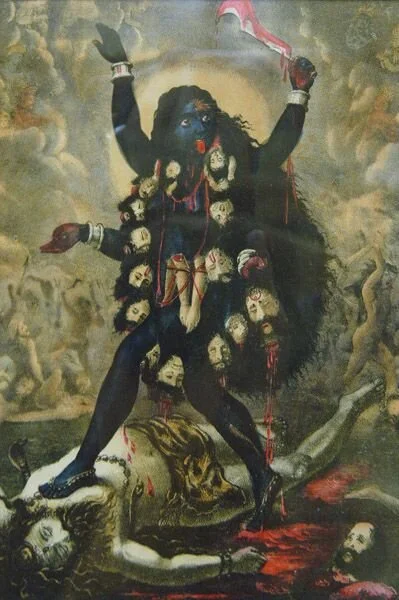
Kali (who signifies the unknown; the un-manifest; death) standing over Shiva. Lithograph, produced by Calcutta Art Studio c. 1908.
A prayer to Kali:
“May I offer conscious space to what is dark and violent within myself. May I be hospitable and present to internal struggle and conflict. May I never ruin a smile by using it to suppress truth. May I never bastardise positivity by using it to suffocate a live emotion. May my practice teach me about limitation, struggle and impermanence. In my surrender, may I remember the meaning of unconditional love.”
Kali is the hindu personification of the un-manifest state. A reminder of nature’s ease in both giving and taking life. With no permanent qualities, she is untethered from the narrative of good and evil. As she slays, her bloodlust becomes seemingly interminable. She represents the terror and inevitability of the unknown.
Kali is the feminine of Kāla - “time” and thus Kali’s destruction could be seen as a metaphor for the way time appears to ravage everything that exists; everything it created. Time rages on, unconcerned with consequence, like Kali. We must either embrace impermanence or struggle, because resistance to reality is futile and only leads to suffering.
Kali is standing on the body of Shiva - the embodiment of Consciousness itself. He is representative of the space in which everything else is perceived. Kāla (and Kali) is an offshoot of Shiva, just as time is an offshoot of consciousness. Whether Shiva is alive or not is less important than his presence and posture of submission in this picture. We must understand that Kali and Shiva are two intimately connected aspects of the same reality.
In essence, Shiva is a mirror to Kali. As the story goes, she experiences a moment of realisation as she stands over him. Suddenly able to witness herself in full fury, she is struck with the inescapable truth of their bond. This meeting of Shiva (consciousness) and the Kali (unknown) represents the marriage of opposing forces. To full experience annihilation is, in some sense, to embody and therefore transcend it.
There is a sense in the Hindu myths and legends that the gods (through whom life’s events manifest) are not only “good” and not only “bad”. In the big-picture worldview, or cosmic play, both suffering and joy, peace and war can all find home in the space of the present moment. Occasionally, an artful poet will beautifully interact with this non-dualist idea that there is unconditional peace beneath the turbulent surface of reality.
Rumi is one such human. His poem, A Great Wagon comes as close as any other:
“Out beyond ideas of wrongdoing and rightdoing,
there is a field. I’ll meet you there.
When the soul lies down in that grass,
the world is too full to talk about.
Ideas, language, even the phrase “each other”
doesn’t make any sense.”